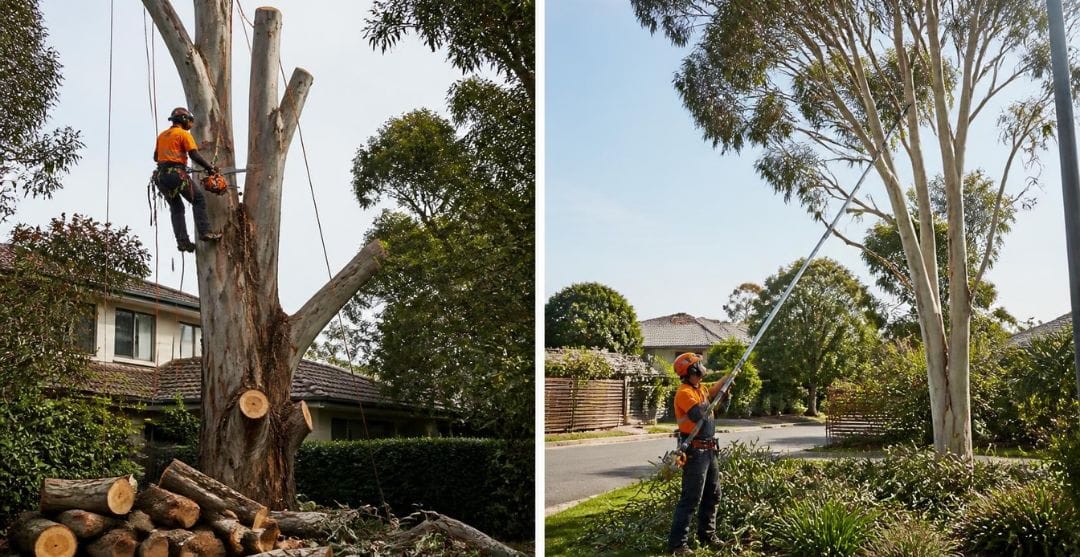
Tree Removal Service vs. Tree Trimming Service in Melbourne —Which Do I Need?
From pruning overgrown branches to dealing with unsafe or storm-damaged trees, the right service depends on what the tree actually needs. Learn how Melbourne’s planning rules can affect tree work, what removal may cost, when emergency work is needed, and what to look for before hiring tree removal services in Melbourne.
Trimming works best when a healthy tree just needs a tidy-up to clear out dead, weak, or stray branches. However, total removal becomes the only safe option if the tree is structurally compromised, diseased, or threatening nearby powerlines and foundations.
Where the tree is growing also matters. A tree close to your house, fence, driveway or powerline needs more care than one in an open part of the yard. Local council rules can also affect what work you can do.
Tree Trimming vs. Tree Removal: What’s the Difference?
Trimming (pruning) selectively removes specific branches to manage the canopy’s shape, health, or size while keeping it alive. Complete removal takes down the entire tree, including stump excavation if needed, when a tree becomes unsafe or dying.
Pruning vs Lopping—Why the Distinction Matters
Not all cutting is equal. The difference affects both tree health and council compliance.
● Pruning: Selected branches are cut back to maintain the health, balance and growth direction of the tree. Work should be in accordance with AS 4373-2007.
● Lopping: Large branches or the tree’s top are cut back. This can leave large wounds, weaken the tree and may not be permitted under local council regulations.
● Removal: The tree is cut down and taken away. The remaining stump can then be ground down or removed if needed.
| Factor | Trimming | Removal |
|---|---|---|
| Tree survives | Yes | No |
| Estimated time | Hours | Half-day to multi-day |
| Council permit | Often not required | Frequently required |
Any negligence in these services wastes money, as you could end up paying for a damaging, careless trim or a full removal when a simple prune would have been enough.
When Should You Opt for Tree Trimming in Melbourne?
Trimming can help when a healthy tree has dead, damaged or unwanted branches, or is blocking light or access. If branches are close to powerlines, don’t prune them yourself; call an authorised or suitably qualified professional for this work.
Signs Your Tree Just Needs a Trim
● Overhanging branches over a roof, driveway or footpath
● Dead or damaged branches
● Branches blocking light to your home or garden.
● Branches growing into fences, power lines, or over your roof. The best time for trimming isn’t necessarily an annual schedule; it depends on the
● Tree’s growth rate and health. For example, Whitehorse Council recommends checking in on some species every 3–4 years to ensure they are growing properly.
When Is Full Tree Removal Unavoidable?
Removal becomes necessary when a tree is unstable, dead, seriously damaged beyond recovery, or its root system is damaging your house, pipes or driveway—problems trimming can’t fix.
Red Flags That Signal Removal, Not Trimming
● Large cracks or splits in the trunk or major limbs
● Fungal growth at the base, often a sign of root decay
● More than 50% of the canopy dead or dying
● Roots visibly lifting paving, driveways or a home’s foundation
● A significant lean that’s developed suddenly, not gradually
● Storm damage that’s compromised the tree’s structural integrity
A tree showing one of these signs doesn’t automatically need removal.
But when there are several problems, it is worth having the tree checked out by a professional expert rather than simply pruning it. This is especially important for mature trees growing close to driveways, buildings or underground services.
Melbourne Council Rules: Do You Need a Permit to Trim or Remove a Tree?
Since September 2025, Clause 52.37 has introduced new canopy-tree controls across Victoria. A qualifying canopy tree is more than 5 metres high, has a trunk circumference above 0.5 metres at 1.4 metres above ground and a canopy diameter of at least 4 metres. Whether a permit is needed depends on the property’s zone, existing dwelling and the tree’s location.
Clause 52.37 and Local Overlays—What Actually Triggers a Permit
Sometimes councils have local laws that apply, like certain height and circumference limits; if it is beyond those, we can’t remove it without a permit, even if there is no overlay on the property.
● Clause 52.37 (statewide): Permit requirements can apply to canopy trees near boundaries, including within 6m of the street frontage or 4.5m of the rear boundary.
● Dead tree removal: In some eastern suburbs, dead trees need a permit or a qualified arborist report.
● Local overlays: Vegetation Protection (VPO), Environmental Significance (ESO) and Significant Landscape Overlays (SLO) apply differently street to street.
● Routine pruning: Light pruning may not need a permit in some areas, but the rules depend on the council, property and tree protection controls. Check the local requirements before pruning.
● Boundary trimming: You can typically trim overhanging branches back to your boundary at your own cost, but can’t remove a neighbour’s whole tree without their consent.
Confirming your property’s overlay status before booking a removal is worth the short delay—particularly across Boroondara, Whitehorse, Knox and Casey, or any other suburb where overlay boundaries can change from one side of a street to the other.
Emergency Tree Removal vs. Routine Care in Melbourne
Emergency removal applies to trees posing an immediate risk—storm-damaged, split, or leaning onto a structure or powerline—and most Victorian councils allow removing only the hazardous portion without a permit, even on protected trees.
What Counts As a Tree Emergency
● A tree or major limb that’s about to fall or has fallen.
● A trunk split following a storm.
● A tree leaning onto a house, fence or powerline
● Root plate lifting, signaling imminent collapse
If a tree poses an immediate risk to people or property, an exemption may permit the removal of the dangerous part. This does not automatically mean the whole tree can be removed without approval. The exact rules depend on the planning controls that apply to the property.
| Factor | Emergency tree work | Routine |
|---|---|---|
| Response time | 24–7 | Planned maintenance |
| Permit needed | Immediate-risk exemption usually applies | Often required for larger trees |
| Typical trigger | Storm, structural failure | Scheduled maintenance |
Cost Comparison: Tree Trimming vs. Melbourne Tree Removal
The price of tree pruning and removal in Melbourne will depend on the size, location and difficulty of the job. AXE Tree Services gives general estimates of $200–$1,500 for tree pruning, $500–$3,000 for tree removal, and $100–$500 for stump removal.
| Service | Indicative price range (per tree) |
|---|---|
| Tree trimming/pruning | $200–$1,500 |
| Tree removal | $500–$3,000 |
| Stump removal | $100–$500 |
| Emergency tree services | May cost more for after-hours work |
These figures are general estimates rather than fixed prices, as the total cost will ultimately depend on your tree’s size, its location, and the job’s overall complexity.
Access can have a big effect on the price. Simple, open spaces make the job easier, and confined areas require special equipment.
Other costs can come up, such as stump grinding, green waste removal, permits, or arborist reports.
How to Choose the Best Tree Removalists in Melbourne
A good tree removalist should do more than cut down a tree. Before booking, check that they have public liability insurance, follow safe pruning practices and can explain whether you need council approval for the work. A clear written quote should also set out what is included in the job.
What to Check Before You Book
● Insurance: Make sure the company has public liability cover for work done on your property.
● Standards: Ask whether the pruning complies with AS 4373-2007.
● Council approval: Before beginning any tree work on your property, find out if council approval is required.
● Written quotes: They should describe the job being done and include information about any expenses associated with equipment, permits, stump grinding, and green trash removal.
● Local experience: Choose a company familiar with the type of tree, property and access conditions involved in your job.
When comparing quotes, don’t look only at the final price. See what you’re actually paying for and if there is any additional work or costs that have been left out. A detailed quote makes it easier to compare services and reduces the chance of unexpected charges later.
FAQ’S
Look for a provider offering 24/7 emergency response with public liability insurance and experience handling storm-damaged or structurally unstable trees—the same-day availability matters as much as the equipment.
AXE Tree Services provides stump grinding and digs up to 150- 300 mm below ground as standard. Also provide handle jobs where access or surrounding structures need careful planning. The service is suited to removing visible stumps and preparing the area for lawn, planting or other landscaping work.
Ans: Look for a provider with public liability insurance, suitable training and experience for the type of work involved. Extra qualifications and authorisations may apply when work is carried out near powerlines
Call AXE Tree Services or choose a company that provides an honest 24/7 emergency callout service, as storm response is often covered by the immediate-risk permit exemption but you still need a qualified, insured tradesperson on site quickly.
Tree removal for commercial and construction sites usually requires a company that’s experienced in traffic management, council rules and operating larger equipment such as cranes, so it pays to specifically look for this experience rather than just residential work.
A qualified provider should be able to explain your property's specific permit requirements, not just quote a price—that ability to discuss Clause 52.37, canopy tree protection and local overlays is a practical sign of genuine expertise.